



An engineering lecturer and construction professional with a PhD in Construction Project Management. He teaches engineering apprentices at Make UK, publishes on AI in construction and builds the software his own classrooms need, including the tools behind Makevise, the EdTech company he founded.
One light for each of his 103 publications and one ring for each year. Every speck swarming a light is a citation of that paper: 2,274 on Google Scholar.
103of 103 publications | 2018 to 2026
Arrange by
Showing all 103
Drag to spin
Point at a light to read it
Click a light to fly to it
Scroll to build his galaxy
103 publications are about to arrive
↔ Drag to spin it | Click a light to fly to it
OpenAI, Oxford and Cambridge
The three names people ask him about first: reward-model work on GPT models in the fifteen months before ChatGPT launched, continuing study at the University of Oxford, and a book he is co-editing with a University of Cambridge researcher.
August 2021 to November 2022 | via contract
RLHF Specialist, GPT model development
01Prompt
02Answers
03His ranking
04Reward model
Prompt Explain why a steel bar necks before it breaks.
A
B
C
D
1st
2nd
3rd
4th
A prompt goes to the model.
Aug 2021Starts, in year three of his PhDNov 2022ChatGPT launches to the public
Turning expert judgement into a signal a model can learn from is the idea he now builds on at Makevise, where his AI marking pipeline learns from how assessors grade.
November 2024 | Continuing Professional Education
Design Coding for Sustainable Development
MUST keep the building line: new homes sit on the same line as their neighbours.
Create Streets, LondonLed the course on writing design codes
Jericho, OxfordSite walk and visual reference survey
CertificatePractical coding, passed
It takes his sustainable construction research from single buildings to whole streets: how a place can change for the better without losing the character people value.
2026 | Book collaboration
Co-editor on his next book
Anson Tsz Kwan Chan of the University of Cambridge co-edits Explainable Computer Vision for Engineering Applications with him for Emerald and ICE Publishing, alongside Abdul Haq and Wang Dalei: twelve chapters on how engineers can see, check and govern what an AI model is doing before they trust it on site.
IIIIII
12 chapters drafted | in final editing | due November 2026
Six years of teaching across the United Kingdom, Malaysia and Pakistan, with research and software that left the lecture room and went into industry.
103Publications: 3 books, 25 journal papers, 35 conference papers and 40 book chapters
2,274Citations on Google Scholar, rising every year since 2020. h-index 26, i10-index 59
272Engineering apprentices taught across 13 cohorts, employed by more than 50 UK companies
94%Less marking time per script with his AI assessment pipeline, 25 minutes down to 1.5
5,000+Assignments assessed by that pipeline so far
97%Student satisfaction at CECOS University, 2022 to 2024
£22MResearch grant collaborations with Total Energies and CIDB Malaysia
Top 1.37%Of scholars worldwide across all fields in the ScholarGPS ranking, and top 0.29% in sustainability
How he teaches
In his words
"Theory earns its place only when a student can trace it to a decision a practitioner would actually make."
"My research and my teaching are the same project. I do not teach about AI and BIM; I deploy them inside the classroom itself, so that students develop the professional instinct to reach for them on site."
"I measure my teaching not by pass rates but by what students become: two Gold Medalists, PhD researchers progressing in China, a construction firm founder, and a project manager delivering infrastructure in the Maldives, all emerging from a single research cluster I built from the ground up."
Dr Syed SaadTeaching philosophy
In their words
Fifteen people have written him a recommendation on LinkedIn: the dean he reported to, research colleagues, and the students he supervised. Across all fifteen, these are the words they reached for most.
30research
22mentor
15students
13dedication
9teaching
8guidance
Built from the classroom
Each of these started as friction a real learner or tutor faced. Each one now has a measured result.
AI assessment pipeline
The problem
Assessing one BTEC engineering assignment properly took about 25 minutes, criterion by criterion.
What he built
A Python pipeline that reads each submission, assesses it against every Pass, Merit and Distinction criterion, writes the feedback and fills the centre's own grading template. This became the Makevise Assessor.
1.5 minutesper submission, across more than 5,000 assignments
Tutor, by hand0:00
Makevise pipeline0 scripts
Press race to watch 25 minutes of marking, sped up.
Tensile Testing Lab
The problem
Apprentices rarely get enough time on a real 100 kN test frame.
What he built
A physics-accurate simulator of BS EN ISO 6892-1 with eight engineering materials, live stress-strain curves from the Hollomon power law, fracture surfaces and a batch QA module.
6 universitiesvalidated it; about 40% higher engagement across two live cohorts
New curriculum
The problem
The engineering programme had no units on sustainability, digital manufacturing or AI leadership.
What he built
Two new units, Environmental Engineering and Sustainability, and Industry 4.0. Then an AI leadership unit for the Skills England framework: 29 criteria mapped across four occupational standards, 35 guided learning hours.
Submittedfor national accreditation
Carbon decision support
The problem
Designers of modular buildings had no quick way to see the carbon cost of their choices.
What he built
His PhD: a generative AI carbon management system that works with offsite modular BIM components.
National tooladopted by CIDB Malaysia; 70% better design decision accuracy
The companies behind his classroom
Since August 2025 he has taught 272 engineering apprentices across 13 cohorts. They are employed by more than 50 UK companies, from Jaguar Land Rover and Rolls-Royce to Severn Trent, Ibstock and Mondelez. The board lists every one.
272apprentices taught
51employers named
10industries
13cohorts
ArrivalsApprentices in his classroom, by employer1 / 700:00
EmployerIndustryApprentices
Counted from his class lists and the provider's progress tracker. Learner names are never shown; nine learners whose employer is recorded unclearly are included in the totals only.
The journey
From Peshawar to the Midlands
2012 to 2017
Peshawar, Pakistan
Where it started
B.Eng Civil Engineering, UET Peshawar
Site engineer on the Lady Reading Hospital extension
Assistant Commercial Manager at Karcon: 35% fewer estimating errors
2017 to 2018
Liverpool, United Kingdom
First time in the UK
M.Eng Construction Management, Liverpool John Moores University
BIM, PRINCE2, lean and sustainable construction
Dissertation on bringing BIM to developing countries
2019 to 2022
Perak and Kuala Lumpur, Malaysia
The doctorate that became national policy
PhD at Universiti Teknologi PETRONAS
His carbon software adopted by CIDB Malaysia as a national tool
Programme Delivery Manager at CIDB, £22M in grant collaborations
2022 to 2024
Peshawar, Pakistan
Home, to build a research cluster
Head of Research Cluster at CECOS University
First AI-focused book published in Pakistan
97% student satisfaction and a PMI Future 50 honour
2024 to today
The Midlands, United Kingdom
Teaching engineers, building Makevise
Sandwell College, University of Derby, University College Birmingham
Engineering lecturer at Make UK, Birmingham, 272 apprentices
Founded Makevise Technologies Limited
A career, scheduled like a project
He trained as a construction project manager, so this is his career drawn the way he would draw a programme: every role, degree, book and review as a bar on one Gantt chart. Drag the status line to any date to see everything that was running at the same time.
Practice
Teaching
Study
Research
Books
Peer review
Milestone
November 20260 running at once
Tap any bar
Open a line of the programme
Each bar is one role, degree, book or journal. Tap it for the detail and highlights.
Research
103 papers, one search box
His work sits where construction meets computing: AI, digital twins, carbon and the circular economy. Search every paper below, or explore them as a galaxy.
AI and generative AI in construction
BIM
Digital twins and robotics
Circular economy
Carbon management
Industry 4.0 and 5.0
Offsite modular construction
Progress monitoring and point clouds
Risk, cost and life cycle analysis
Published by
The houses behind his 103 publications. Tap one to filter every paper below, and the galaxy above.
What began as a research cluster in Peshawar now spans 16 hours of time zones, from Fargo to Brisbane, so somewhere a co-author is always at work. The dial below runs on real time: the bright band is daylight right now, and the people inside it are at their desks.
17co-authors
12institutions
8countries
0at work right now
Live00:00 in the UK
Joint papers counted from the author lists on his Google Scholar profile. Local times come from your device's clock.
Three books, 36 chapters
As lead editor, he took three books from proposal to print with CRC Press and Emerald, and co-wrote 35 of their 36 chapters with authors from his research cluster. Take a book off the shelf to open it.
3published books
36chapters
35co-written by him
800+pages
34contributors
Opening the black box
His next book, as lead editor for Emerald and ICE Publishing, asks a question every engineer should put to an AI model before trusting it on site: why did you decide that? It brings together 17 contributors across 12 chapters, and is now in final editing.
Emerald | ICE Publishing
Explainable Computer Vision for Engineering ApplicationsTransparency, Governance, and AccountabilityEdited by Syed Saad, Abdul Haq, Wang Dalei and Anson Tsz Kwan Chan (University of Cambridge)
Publisher
Emerald and ICE Publishing
His role
Lead editor and chapter author
Co-editors
Anson Tsz Kwan Chan, University of Cambridge; Abdul Haq; Wang Dalei
Scope
12 chapters, 3 parts, about 100,000 words
Status
In final editing, manuscript due November 2026
What explainability looks like
Model outputCrack detected
94% confidence
An inspection model looks at a concrete wall and reports a crack with 94% confidence. On its own, that is a number you have to take on trust.
Part ICore concepts and methods
01The need for explainability in engineering computer vision systems
02Explainability techniques: saliency maps, LIME, SHAP and counterfactual explanations
03Data handling, provenance and preprocessing for transparent CV models
04Metrics, benchmarks and uncertainty quantification for XCV in engineering
Part IIGovernance, validation and deployment
05Bias detection, auditing and debugging XCV models in engineering
06Human-in-the-loop XCV: explainable interfaces and workflows for engineers
07Algorithmic governance, the right to explanation and regulatory compliance in engineering AI
08XCV deployment pipelines, software integration and adversarial robustness
Part IIIDomain case studies
09XCV for robotics and autonomous construction systems
10XCV in infrastructure, structural health monitoring and predictive maintenance
11XCV in electrical, aerospace and emerging engineering applications
12The future of XCV: neuro-symbolic, self-explaining and sustainable engineering models
Education
Civil engineering in Peshawar, construction management in Liverpool, and a doctorate in Malaysia that ended as national policy.
PhD
Construction Project Management
Universiti Teknologi PETRONAS, Malaysia. 2019 to 2022. Distinction, with the Graduate on Time award.
Gen-AI Carbon Management Software for Modular Construction. Adopted by CIDB Malaysia.
M.Eng
Construction Management
Liverpool John Moores University, UK. 2017 to 2018. RICS accredited, PRINCE2 certified, with a collaborative BIM project.
Challenges to implementing BIM technology in developing countries.
B.Eng
Civil Engineering
University of Engineering and Technology, Peshawar. 2012 to 2016.
Non-destructive analysis of the historic Attock Railway Bridge using SAP2000.
Earlier: F.Sc Pre-Engineering, Islamia College Peshawar; Edwards College School, Peshawar.
Recognition
The hall of honours
Five honours
Step into the gallery
Scroll and the lights come up, one plinth at a time. Keep scrolling to walk along the honours.
Full PhD Scholarship, Graduate Assistant Merit Award and Graduate on Time Award, Universiti Teknologi PETRONAS
Outstanding Faculty, CECOS University of IT and Emerging Sciences
First AI-focused book published in Pakistan, endorsed by the EU Ambassador to Pakistan and the Ambassador of Tunisia
Lead conference speaker invited by IOM3 on AI in materials, Birmingham, November 2025
PMI Future 50 honoree, Project Management Institute, 2024
63 certificates, one habit
He keeps learning in public, and asks his students to do the same: he has guided 2,500+ learners from remote backgrounds to free certifications from IBM, Oracle, MathWorks and Bentley. Every tile below is one of his own certificates, stacked by the year he earned it. Filter by theme, or tap a tile to read it.
63 certificates | 2016 to 2026
Tap a tile
Each tile is a certificate, coloured by theme and marked with its issuer.
A periodic table of his toolkit
Every tool here has a job he has done with it. Tap an element to see where he used it, from the 23,000-node Grasshopper model behind his PhD to the Python pipeline that marks apprentice work today.
Standing and partners
Professional memberships, the journals that trust him to review, the workshops he has led and the organisations his work has served.
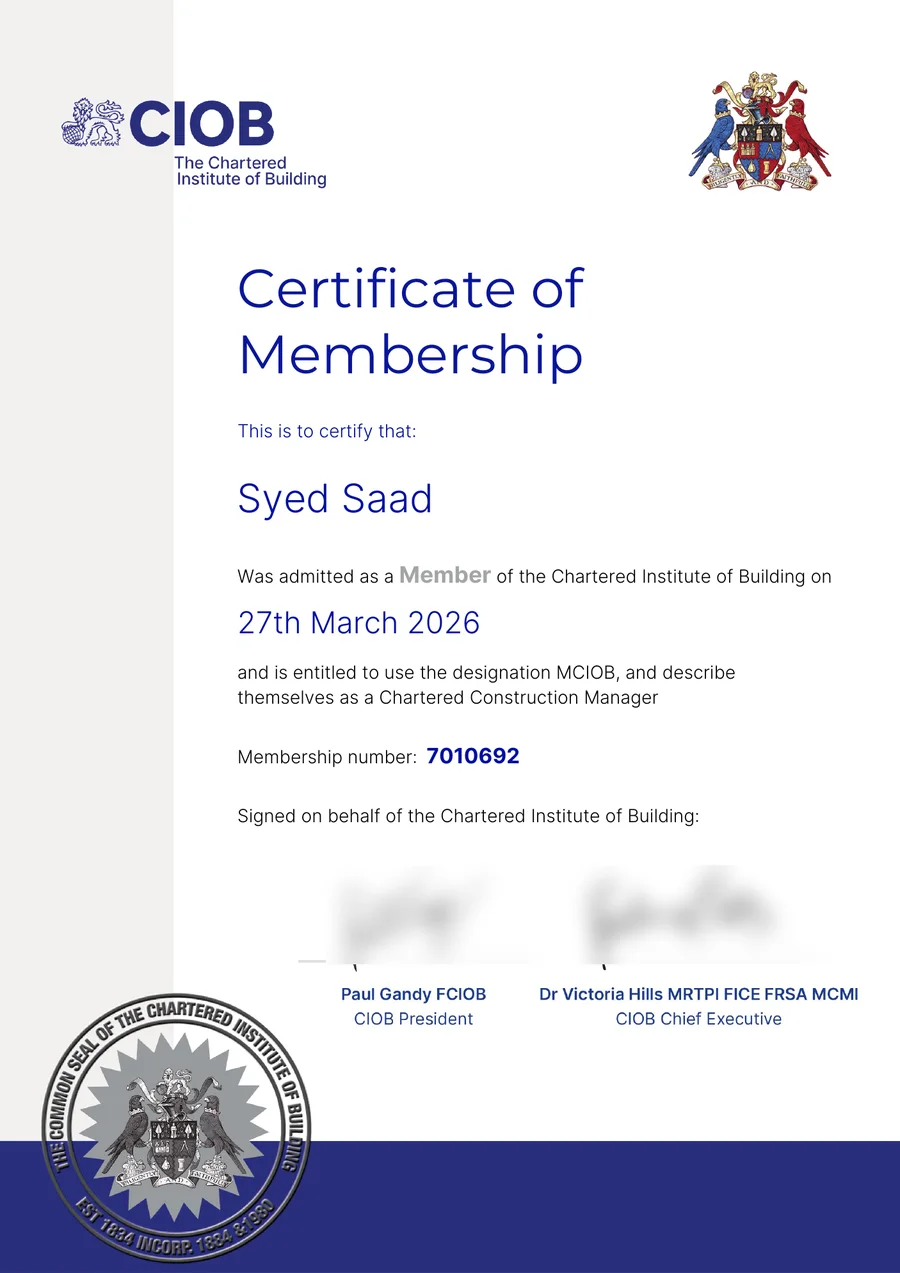
Tap to view. Signatures blurred for this page.
The Chartered Institute of Building
Chartered Construction Manager
Admitted as a Member of the CIOB, entitled to use the designation MCIOB and to describe himself as a Chartered Construction Manager.
Admitted
27 March 2026
Designation
MCIOB
Membership number
7010692
Institute
Chartered Institute of Building, est. 1834
Professional standing
CSCS White Card, Academically Qualified PersonConstruction Skills Certification Scheme, valid to 2031
Royal Institution of Chartered SurveyorsRICS professional member
Registered Civil EngineerPakistan Engineering Council
Peer reviewer for
ElsevierAin Shams Engineering Journal, Chemosphere, Environmental Research